Traditional Luggage Label vs QR Tag
By ContactMeTag · · 7 min read
You only need to stand at a baggage carousel for ten minutes to see the problem. A suitcase goes missing, the owner is tired, airport staff are stretched, and the only contact detail on the bag is a faded paper card with a home address printed for anyone to read. That is where the traditional luggage label vs QR tag question stops being theoretical and becomes very practical.
For Australian travellers, this choice comes down to three things: how quickly someone can contact you, how much personal information you are exposing, and what actually works when plans go sideways. A basic luggage label still has a place, but it was designed for a simpler travel era. A QR tag is built for faster contact, better privacy, and the real-world messiness of missed connections, delayed bags and interstate or overseas travel.
Traditional luggage label vs QR tag: what changes in real life?
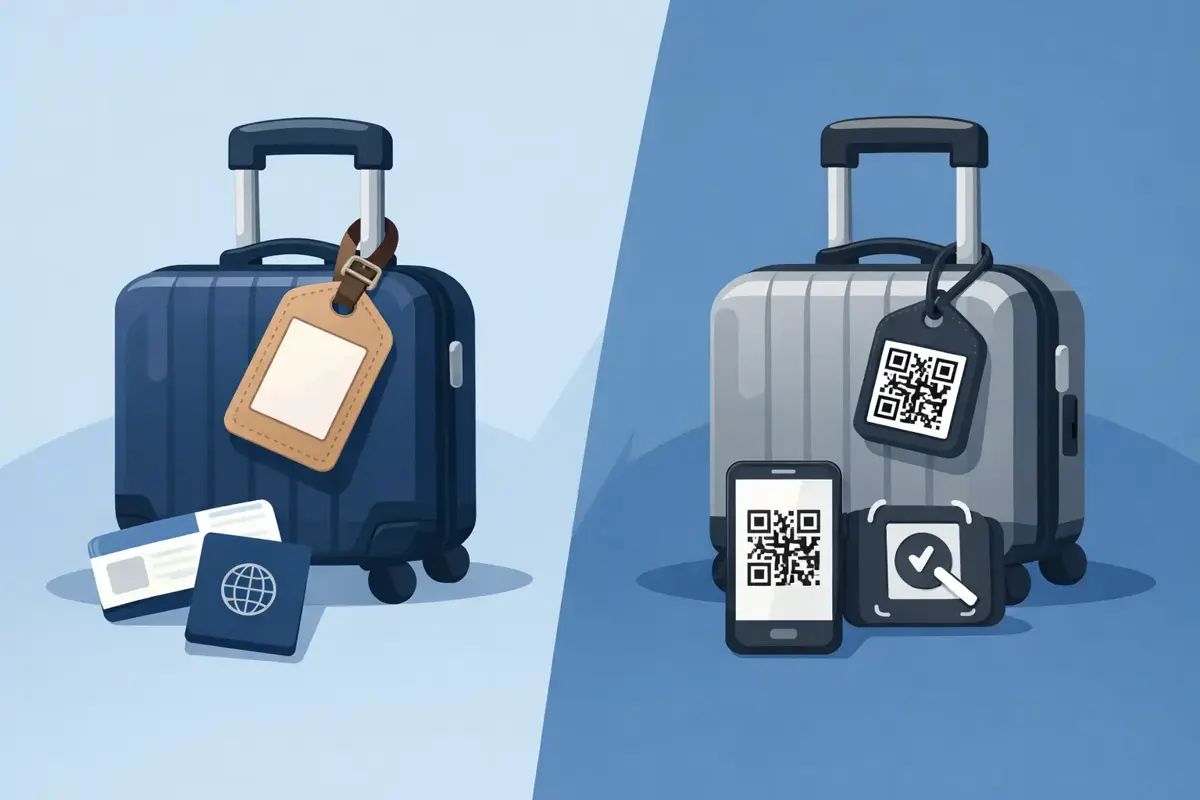
A traditional luggage label does one job. It shows your name and contact details so a person can try to reach you if your bag is found. In the best-case scenario, that works. An airline worker, hotel staff member or helpful stranger sees the label, reads your details and gives you a call.
The weakness is obvious the moment you look at the label. Your private information is sitting in public view. Depending on what you write, that could be your full name, mobile number, email address or home address. Many travellers now avoid listing everything because it feels risky. That instinct is sensible, but it also means the label becomes less useful.
A QR luggage tag works differently. Instead of displaying your personal details on the outside of the bag, it gives the finder a fast way to contact you by scanning the code. The contact process is routed digitally, so communication can happen without publishing your number for everyone in the terminal, taxi rank or hotel lobby to see.
That is the real shift. A traditional label displays information. A QR tag creates a contact pathway.
Privacy matters more than most travellers realise
When people compare a traditional luggage label vs QR tag, privacy is often treated like a bonus feature. It is not. It is one of the main reasons many travellers are moving away from handwritten or printed labels.
A luggage tag is attached to an item that moves through airports, rideshare boots, hotel storage rooms and public spaces. If it shows your home address, you are effectively advertising where you live. If it shows your personal mobile, you are trusting that only the right people will use it. Most people are honest, but travel safety should not depend on optimism.
A QR tag reduces that exposure. A person can still reach you quickly, but your details do not need to be sitting on display. For families travelling with children, solo travellers, older travellers and anyone carrying expensive gear, that privacy buffer is not just convenient. It is sensible.
This is especially relevant when you are away from home for several days. A suitcase label that says exactly who you are and where you live can reveal more than it should. A smarter tag lets you stay contactable without making your private information public property.
Speed of recovery is where QR tags pull ahead
If your bag is misplaced, speed matters. The longer it sits unclaimed or unidentified, the more complicated recovery can become. Traditional labels rely on someone reading your details correctly and making the effort to contact you through the method you provided.
That may sound simple, but plenty can go wrong. Handwriting can be hard to read. Ink can smudge. Paper inserts can slip out. Old labels can still carry outdated numbers. Even when the information is accurate, an international finder may hesitate to call an unfamiliar number.
A QR tag removes several of those friction points. A quick scan on a mobile can take the finder straight to a contact option. No guessing, no squinting at faded text, no need to decide whether they should call, text or email. That can make a genuine difference when someone has only a minute to help before moving on.
For travellers in transit, that extra speed matters. If your luggage is left in a transfer area, at a hotel desk or in the back of a shuttle, a quick contact route gives you a better chance of sorting it out before the item is moved again.
Reliability depends on the situation
This is where the answer is not completely one-sided. A traditional luggage label has one major advantage: it is visible and does not require a phone camera or internet access to understand its basic purpose. Anyone can read it immediately.
That matters in low-tech scenarios. If a finder does not know how to scan a QR code, has a flat mobile, or is in a place with poor reception, a printed label still offers a fallback. It is simple, familiar and requires no explanation.
But that simplicity also limits what it can do. It cannot mask private details. It cannot be updated once printed unless you replace it. It cannot route contact to different people depending on the situation. If your number changes, the label becomes wrong. If you are on a flight and unreachable, the tag does not adapt.
A QR tag is stronger when flexibility matters. If your digital details can be managed online, you can keep the contact pathway current without reprinting your personal information every time your plans change. That is a big advantage for frequent travellers, families and anyone who wants a system that keeps working trip after trip.
Which option is better for Australian travellers?
For most people, a QR tag is the stronger option because modern travel is fast, crowded and unpredictable. It gives finders a direct action to take, protects your privacy better than a visible address card, and suits the way people communicate now - through their mobiles, immediately, on the spot.
That said, the best answer can depend on who you are and how you travel.
If you fly once every few years, mostly domestically, and prefer the absolute simplest setup, a traditional label may feel familiar enough. Just be careful about what personal information you display.
If you travel regularly for work, take family holidays, move through multiple airports, or simply want a faster and more private way for people to reach you, a QR tag is the more practical tool. It is also a better fit for travellers who do not want their full contact details hanging off the handle of a suitcase.
For many people, the smartest setup is not choosing one or the other in a rigid way. It is making sure your bag has a clear external identifier and a modern contact method that works quickly. The best systems are the ones that reduce delay, reduce confusion and reduce the amount of personal information exposed to strangers.
What to look for in a luggage QR tag
Not all QR tags are equal. A good luggage tag should be durable, easy to scan, weather-resistant and simple to set up. It should not force the finder to download an app or jump through extra steps. In a lost-and-found situation, every extra tap is a chance for the person helping to give up.
It should also be privacy-first. The point is not just to add technology to your bag. The point is to make contact easier while keeping your personal number and address protected.
That is where a purpose-built system stands apart from a homemade QR sticker. A proper tag and contact-routing setup is designed for urgent moments, not just convenience. When you cannot speak for your bag, your tag needs to do the talking clearly and quickly.
The old label still works - but it no longer leads
Traditional luggage labels are not useless. They are cheap, familiar and easy to understand. But they belong to a time when public contact details felt normal and travel recovery was slower, more manual and less privacy-conscious.
A QR tag reflects what travellers now expect - fast communication, fewer barriers and better control over personal information. It suits the way Australians travel today, whether that is a weekend in Melbourne, a family trip to Bali or a long-haul journey with multiple stops and too many moving parts.
If you are deciding between a traditional luggage label vs QR tag, ask one practical question: if your bag is found by a stranger in a busy moment, what gives them the quickest safe way to reach you? In most cases, the answer is the option that keeps your details private while making contact immediate. That is why more travellers are choosing QR-based tags from providers such as ContactMeTag.
Travel does not need to be perfect to be safe. Sometimes one smart label on your bag is enough to turn a frustrating delay into a fast return.