How to Label School Bags Safely and Privately
By ContactMeTag · · 6 min read
A school bag can be left on a bus, picked up by mistake after sport, or separated from its owner during a busy excursion. Knowing how to label school bags safely means making it easy for a helpful adult to get in touch, without putting your child’s private details on display to everyone who sees the bag.
The safest label is clear enough to be useful in a real-world moment, but discreet enough that it does not advertise a child’s name, school, address or family phone number. That balance matters. A bag label should help a lost item find its way home, not give strangers a shortcut to personal information.
Why traditional bag labels can create a privacy problem
Writing a child’s full name, mobile number, home address and school class directly on a luggage tag is quick. It is also more information than a finder needs. A bag sits in classrooms, playgrounds, change rooms, buses and on footpaths. Anyone can read an exposed label, whether they are trying to help or not.
A first name alone is usually not enough to return a bag, while a full name paired with a school logo or address can reveal too much. Even a parent’s mobile number, although well intentioned, becomes publicly visible and can be copied, photographed or misused.
This does not mean you should leave a school bag unlabelled. Unlabelled bags are harder to identify, particularly when several children have the same popular backpack, drink bottle or lunch bag. It means choosing a contact method that gives a genuine finder a safe way to act.
How to label school bags safely: use the minimum details needed
Start by deciding what a finder actually needs to do: identify that the bag belongs to someone and contact a responsible adult. They do not need your child’s full identity or where they live.
For an ordinary written label, use a surname or family name and one parent or carer contact number, placed inside the bag rather than on the outside. You might write “Property of the Nguyen family” with a mobile number. Avoid adding the child’s first name if the bag already has a name embroidered across the front.
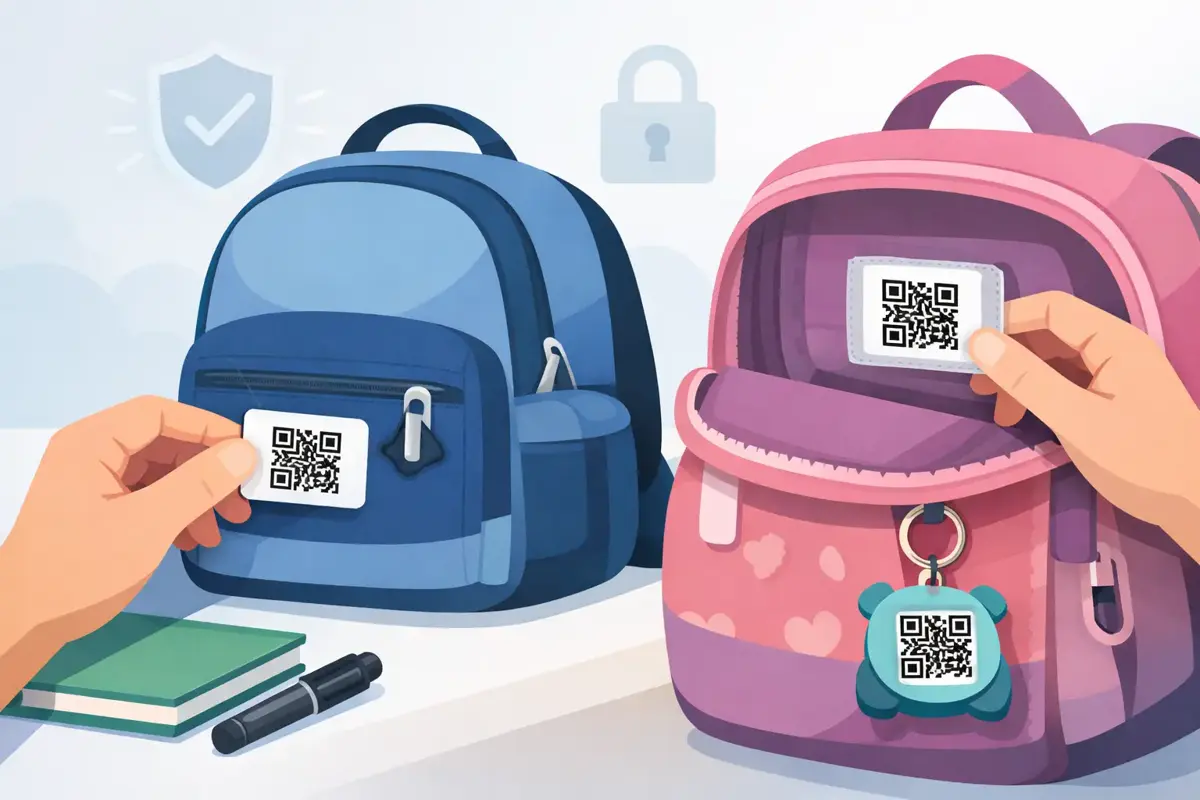
An even more privacy-conscious option is a QR contact tag. When scanned with a mobile camera, it can route a finder to the owner or nominated emergency contact without showing the underlying phone number. The finder does not need to download an app, create an account or know who the bag belongs to before making contact.
This approach is especially useful for younger children who may not know a parent’s number, or when a bag goes missing outside school hours. A Good Samaritan can scan, call or send a message straight away, while your family’s contact details stay masked.
Put identification in more than one place
A bag can lose a zip pull, a keyring tag can break, and an outer label can become scratched or covered in mud. Use a layered approach so one lost label does not turn a recoverable item into anonymous property.
Place a durable, weatherproof contact tag on an easy-to-see external point, such as the top carry handle or a sturdy zip pull. It should be visible to someone who finds the bag, but not dangling so low that it drags, snags or is easily removed. Check that it does not interfere with zips, reflective strips or the way the bag sits on your child’s back.
Then add a second identifier inside the main compartment. This can be a fabric label, a written card in a clear sleeve, or a small contact tag secured to an internal loop. The internal label is useful if the external one is damaged or if the school needs to confirm ownership after the bag is handed in.
Also label the things that regularly come out of the bag. Jumpers, hats, lunch boxes, drink bottles, library bags, pencil cases and sports gear often reach lost property separately. A bag label cannot help when the missing item is a loose school hat on the oval.
Choose a label that can handle school life
School bags have a hard life. They are dropped near the canteen, crammed into lockers, thrown in the back of the car and exposed to rain at the bus stop. Paper stickers and ink-only labels may look fine in week one, then become unreadable after a few washes or wet-weather days.
Choose a label made for regular handling. It should be waterproof, easy to wipe clean and firmly attached. If you use a QR tag, test the code after attaching it. A tag that is bent around a narrow strap, hidden under a flap or covered by a keychain may be difficult to scan when it counts.
Position also depends on the bag. A large primary school backpack may have a solid top handle that suits a visible tag. A slim high school laptop bag may be better with a tag on a side loop or internal compartment. For sports bags, avoid placing it where wet towels or muddy boots will constantly rub against it.
Set up the contact details before the first school day
A label is only as useful as the information behind it. If you use a QR contact solution, activate it before attaching it to the bag and scan it yourself using another mobile. Check that the contact route works, messages can be received and the person listed knows they are the nominated contact.
Use an adult as the primary contact, not the child. Consider adding a second trusted contact as backup, such as another parent, grandparent or carer. This can make a real difference if you are in a meeting, driving, out of mobile range or temporarily unable to answer.
Keep details current. Update them after a new mobile number, changed care arrangement or a move. Before school camps, interstate travel or a holiday with relatives, check that the right person can respond quickly. A contact tag should reflect the people who can take action now, not the details that were correct last year.
ContactMeTag provides this kind of privacy-first contact route through a durable physical QR tag and online setup. It gives a finder a simple path to reach the right person while keeping private phone numbers out of public view.
Teach your child what the label is for
A safe label works best alongside a simple family plan. Explain that the label is there to help a trusted adult return their belongings, not to share with friends or strangers for fun. Younger children can be taught to take a lost bag, hat or jumper to a teacher, school office or bus driver rather than trying to solve it alone.
It is also worth showing children what a QR code tag does in age-appropriate language. “If your bag is lost, a helpful person can scan this so Mum, Dad or another grown-up can be contacted.” Keep the explanation calm and practical. The goal is reassurance, not worry.
For older children, discuss the reason for not displaying their full name and phone number. Privacy is easier to practise when they understand that personal details are not just for anyone to collect.
Avoid these common school bag labelling mistakes
The biggest mistake is putting too much information on the outside of the bag. Skip home addresses, dates of birth, medical details, daily routines and full parent names. If medical information needs to travel with your child, follow the school’s care-plan process and keep it in the appropriate internal location rather than on a public bag tag.
Another common issue is using only a school logo or house colour as identification. These may help staff narrow down where a bag belongs, but they do not give an after-hours finder a way to reach a family.
Finally, do not set and forget. At the start of each term, take thirty seconds to check the attachment, scan any QR code, and make sure the contact information still reaches the right adult. It is a small routine that can prevent a lost bag from becoming an expensive replacement job.
The best school bag label is not the one with the most information. It is the one that lets a decent person act quickly, protects your child’s privacy, and gets their belongings back where they belong.