Holiday Home Emergency Contact Sign That Works
By ContactMeTag · · 7 min read
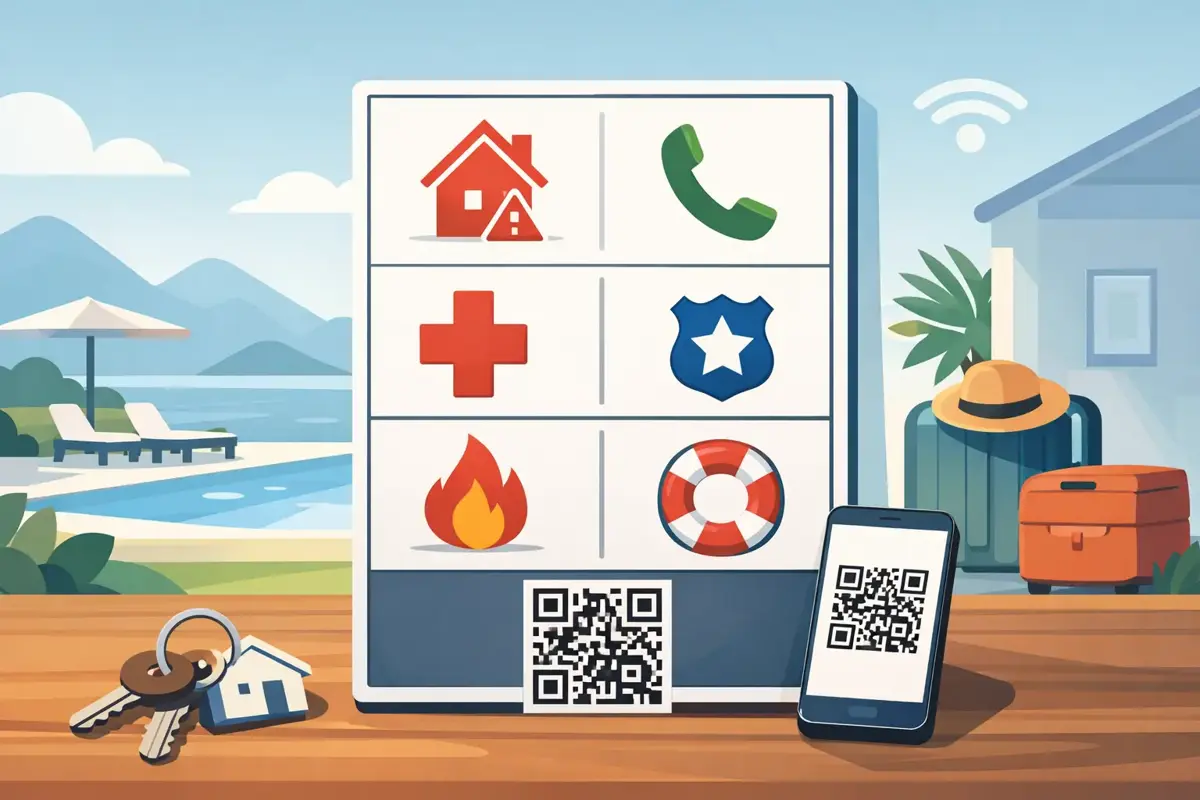
A burst pipe at 9 pm, a guest locked out after a flat mobile battery, a neighbour spotting smoke near the bin area - these are the moments when a holiday home emergency contact sign stops being a nice extra and starts doing real work.
If you own or manage a short-stay property, speed matters. People need to know who to contact, when to call, and how to get help without guessing. Just as important, you do not want your private mobile number stuck on a wall for every guest, cleaner, tradie and passer-by to see. A good sign solves both problems at once.
Why a holiday home emergency contact sign matters
Holiday homes have a different risk profile from a lived-in house. Guests are unfamiliar with the property, the appliances, the local area and sometimes even basic things like where the mains water shut-off is. They are also more likely to need help outside business hours, because that is when most people actually use the place.
In that setting, unclear contact details create delay. Delay can turn a minor issue into property damage, a bad review, or a genuine safety event. If a guest smells petrol, loses power, cannot enter the property, or notices water coming through the ceiling, they need a clear next step immediately.
That is why the sign should do more than display a phone number. It should guide action. It should tell people who to contact for urgent property issues, what counts as an emergency, and how to reach help fast. If your property has a pool, a steep driveway, a septic system or remote access, that need becomes even stronger.
What makes an emergency contact sign actually useful
The best signs are simple enough to read under stress. That sounds obvious, but many are overloaded with tiny text, multiple numbers and vague wording. In an emergency, people scan for certainty. They do not want a puzzle.
A useful holiday home emergency contact sign needs three things. First, it must be easy to spot. Second, it must be easy to understand in seconds. Third, it must connect the person to help straight away.
Printed contact numbers can still work, especially for a local manager or emergency services. But there is a privacy trade-off. Once a number is displayed in a public-facing or semi-public space, you lose control over who has it, who stores it and when they might use it later. For many owners, especially those managing properties remotely, that is not ideal.
This is where a QR-based approach makes practical sense. A scan can route the guest or neighbour to the right contact path without publicly exposing your personal number. It also gives you more flexibility if your emergency contact changes, because the digital destination can be updated without reprinting the entire sign.
Where to place a holiday home emergency contact sign
Placement matters as much as wording. If the sign is hidden inside a kitchen drawer or buried in a welcome folder, it is not doing its job.
For most properties, the main sign should be placed in a highly visible indoor location such as near the entry, kitchen or notice board area. These are the spots guests naturally look when they need property information. A second sign near the back door, laundry or utility area can help for water, power or appliance issues.
Some homes also benefit from a small external sign, particularly if neighbours, gardeners or cleaners may be first to spot a problem while the property is vacant. This needs a bit more care. Outdoor placement increases visibility, but it also increases exposure. If you use an outside sign, keep it focused and privacy-safe.
Remote holiday homes have extra considerations. If mobile reception is patchy, include more than one contact route where possible. If the property relies on tank water, solar systems or coded access, your sign should reflect that reality rather than using generic wording.
What information to include
The right content depends on the property, but the goal is always the same - reduce hesitation.
Start with a clear heading such as Emergency Contact or Urgent Property Help. Then make it obvious what the guest should do. If there is immediate danger, tell them to call 000 first. That instruction should never be buried.
After that, include the primary contact path for urgent property issues. This may be a property manager, host, caretaker or QR code that routes to the right person. If you rely on a digital contact system, make sure the sign explains what happens when scanned in plain language. People are more likely to use it if they know they can call or message without needing to download an app.
It can also help to include short prompts for common emergencies, such as water leak, power outage, lockout, petrol smell or security concern. You do not need a long manual on the wall. You need just enough structure to help a stressed person act quickly.
Avoid cluttering the sign with checkout rules, Wi-Fi details and house tips. Those belong somewhere else. An emergency sign should stay focused on urgency.
Privacy is not a small detail
For holiday-home owners, privacy often gets treated as secondary until it becomes a problem. A printed mobile number seems easy, right up until guests call weeks later about missing chargers, neighbours ring after hours for non-urgent matters, or your contact details get shared more broadly than intended.
A better setup protects access without exposing identity. That is the sweet spot. Guests and helpers still get through fast, but your direct number stays masked. It is a more secure way to be reachable, especially for owners who self-manage, rotate between managers, or use family members as backup contacts.
This is one of the strongest reasons a QR-enabled sign suits short-stay properties. It gives the property a contact point, not just a person’s personal number. That distinction matters.
Why QR works well in real emergencies
A QR sign is not about tech for tech’s sake. It is about reducing friction when someone is under pressure.
Most guests already know how to scan a code with their mobile phone camera. They do not need to install anything, remember a booking portal login, or search old emails for host details. They point, scan and act. In a genuine problem, that speed is valuable.
For owners, the advantage is control. You can direct urgent property contact through a single system, update nominated contacts if management changes, and keep communication consistent across the property. For a business like ContactMeTag, that is the practical value of pairing a physical sign or tag with digital contact routing - fast communication without handing out private numbers to everyone who walks through the door.
That said, QR should not be your only line of defence if your guests skew older, reception is poor, or the property is in a black spot. It depends on your location and audience. In some homes, the best answer is a combined setup: a QR code for instant routing plus a backup local number for critical cases.
Common mistakes that weaken your sign
The first mistake is being too vague. If the sign says Contact host if needed, people are left deciding what counts as needed. A better sign gives examples of urgent situations.
The second is overloading the design. Five numbers, a block of house rules and a paragraph of fine print make the key action harder to find. If someone has to stop and think, the sign is already less effective.
The third is forgetting the vacant-property scenario. Not every emergency will be discovered by a guest. Cleaners, neighbours and maintenance workers may be the first to notice a break-in, storm damage or water leak. Your contact system should work for them too.
The fourth is letting the information go stale. Holiday homes change managers, trades, lock systems and local support contacts all the time. Review your sign regularly, especially before peak season.
A practical setup for most holiday homes
For many Australian holiday properties, the strongest setup is straightforward. Place one main emergency contact sign inside the property where guests will see it quickly. Keep the wording direct. Tell people to call 000 if there is immediate danger. Provide a fast route for urgent property issues. Add a QR code that connects them to the right contact without revealing your private number. Then review it whenever your management or emergency process changes.
If your property is large, remote or has higher-risk features like a pool, wood heater, coded gate or long driveway, add one or two secondary signs in the most relevant spots. Keep the design consistent so guests recognise it instantly.
Preparedness at a holiday home is not about making the place feel clinical. It is about making sure the right person can be reached in the moment it matters. When you cannot be there yourself, your sign needs to do the talking - clearly, quickly and without compromising your privacy.